

Sizing PV+BESS Systems
Why optimal storage sizing comes from integrated assessment, not rules of thumb, and how sensitivity analysis shapes robust investment decisions.
One of the most common questions in renewable energy and storage development is deceptively simple: How large should the battery be? 2-hour or 4-hour duration? 5 MW or 10 MW of power?
The answer is rarely straightforward. The optimal battery configuration is not a standard value. It emerges from the interaction of technical, commercial and market-specific factors.
There Is No Universal Answer
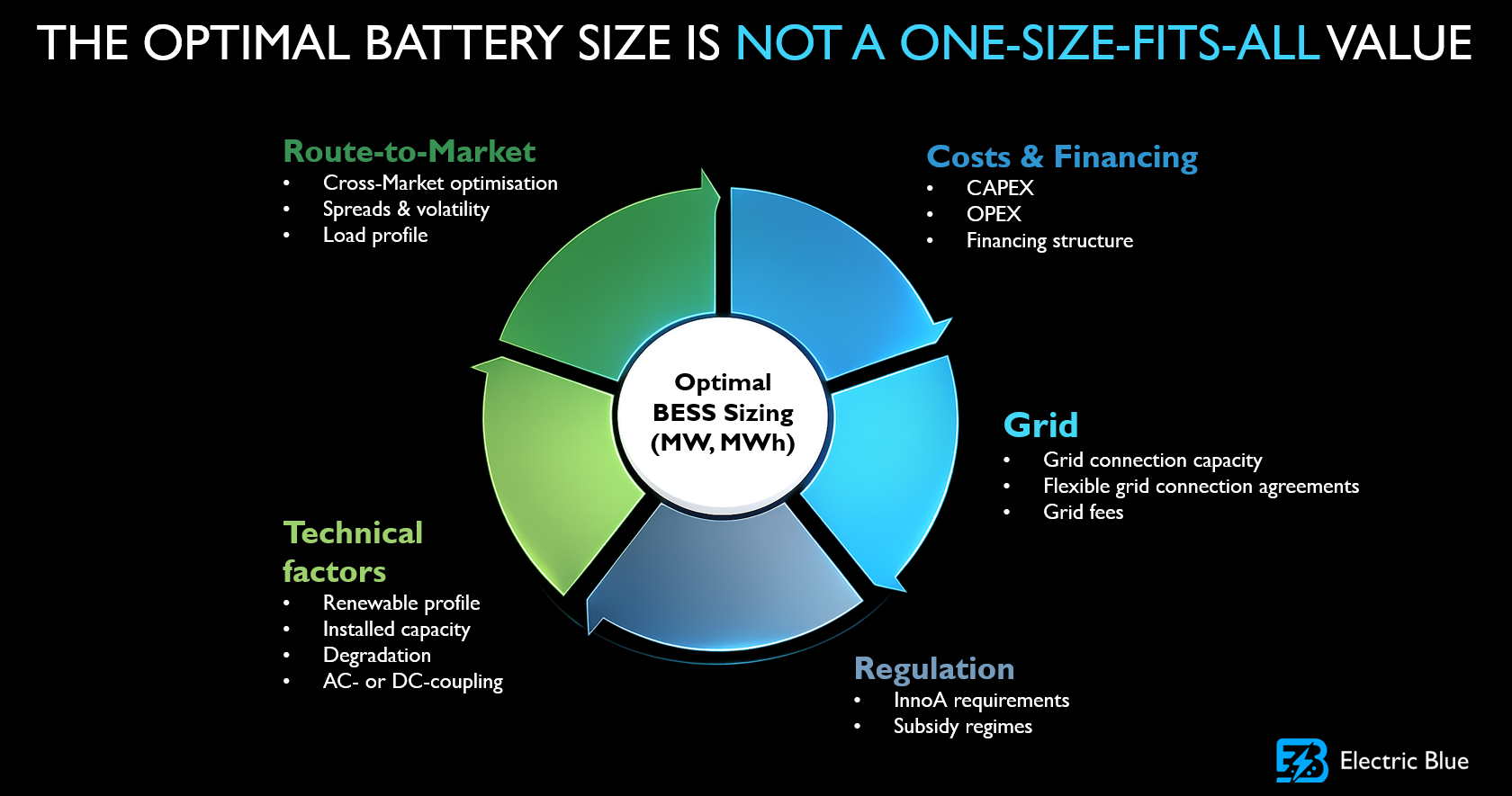
Battery sizing depends on much more than the renewable generation profile.
Market opportunities, grid connection characteristics, financing assumptions, regulatory requirements and project-specific operating strategies all influence the optimal configuration.
As a result, two seemingly similar projects can have very different optimal battery sizes.
Revenue Potential Is Only One Piece of the Puzzle
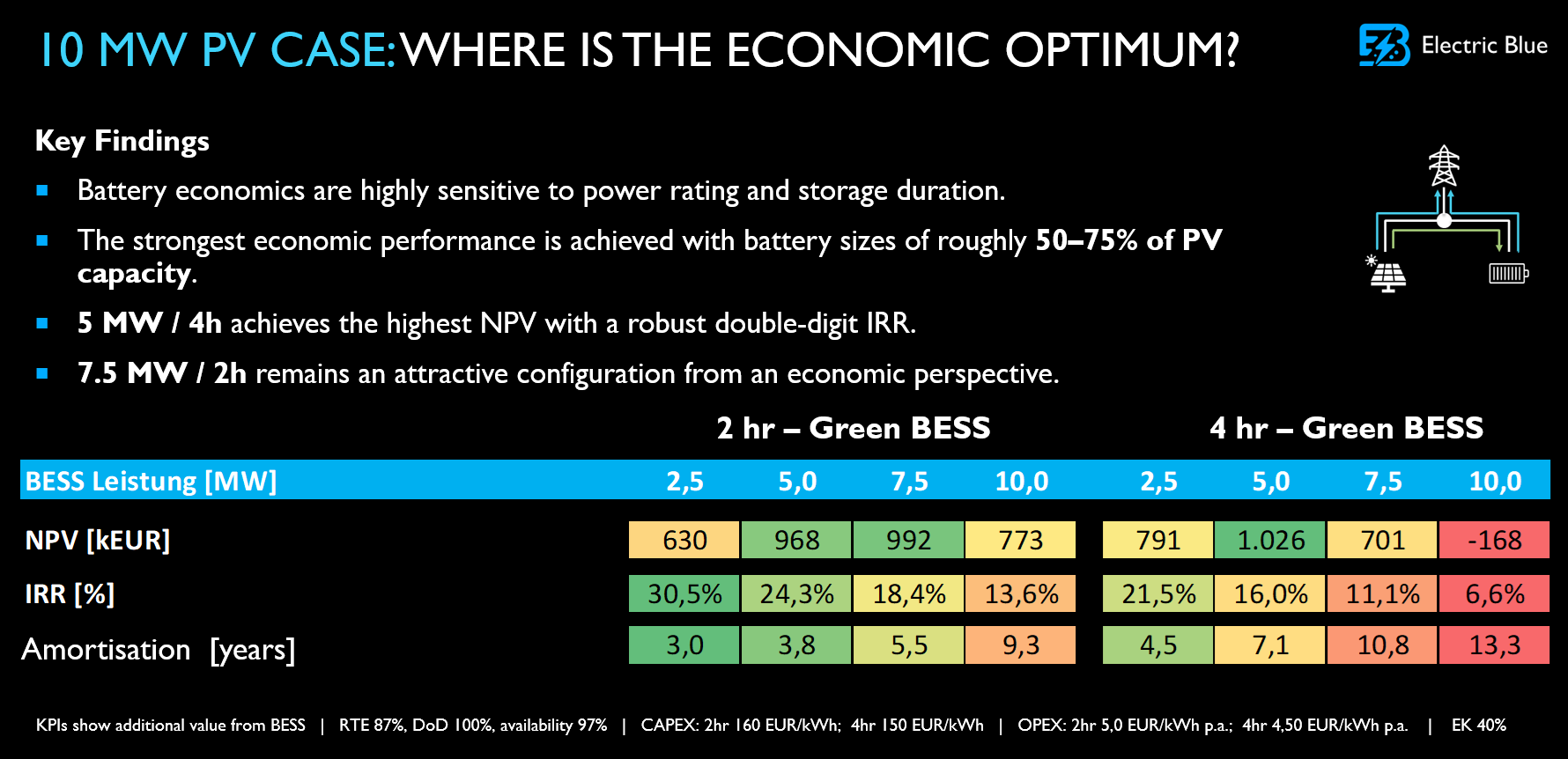
Larger batteries generally create access to additional market opportunities and flexibility value.
However, maximising revenues does not automatically maximise project value. The commercially optimal configuration depends on how additional revenues interact with investment costs, operating expenses and financing structures.
This is why battery sizing should always be approached as an integrated optimisation exercise rather than a simple revenue comparison.
In our example, the highest project value is achieved neither with the smallest nor the largest battery configuration. Instead, the optimal solution emerges from balancing additional revenues against investment requirements and financing conditions.
The Importance of Sensitivity Analysis
Project economics are highly sensitive to key assumptions. Changes in capital costs, operating expenses, financing conditions or market revenues can significantly influence project performance and alter the attractiveness of different battery configurations.
Understanding these sensitivities is essential for identifying solutions that remain attractive under a wide range of future scenarios.
CAPEX Sensitivity
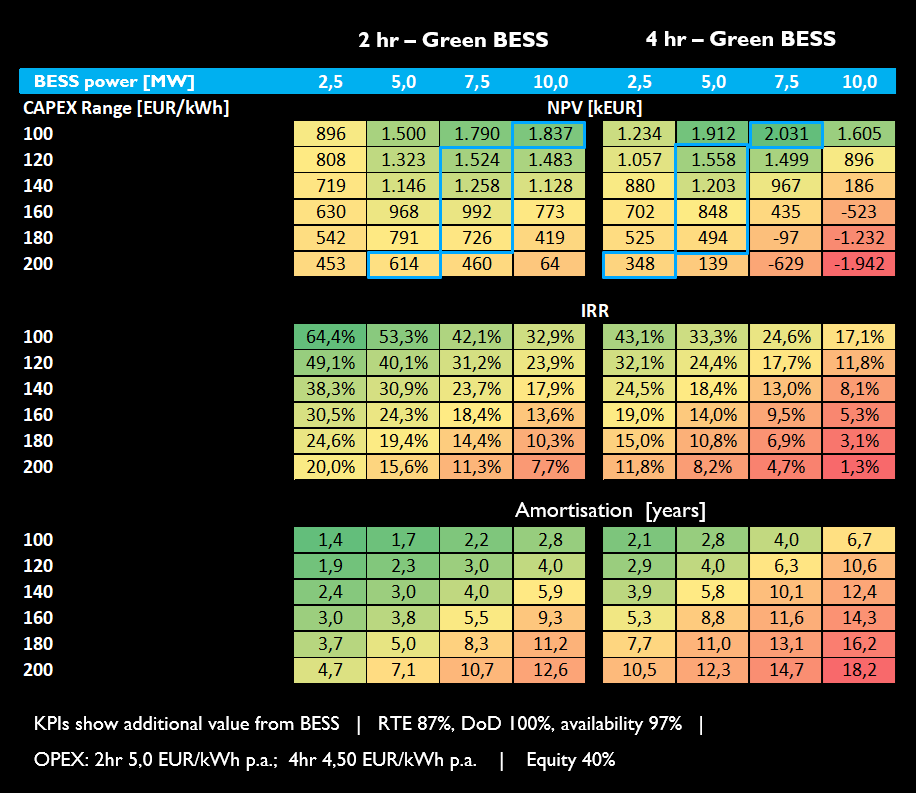
Even moderate changes in investment costs can materially affect project returns. While some battery configurations quickly lose attractiveness as CAPEX increases, others remain economically robust across a wide range of assumptions.
In our example:
- The 5 MW / 4h configuration remains economically attractive across a wide range of CAPEX assumptions.
- The 7.5 MW / 2h configuration also demonstrates robust economic performance.
- Larger 4h systems lose their economic attractiveness relatively quickly as CAPEX increases.
OPEX Sensitivity
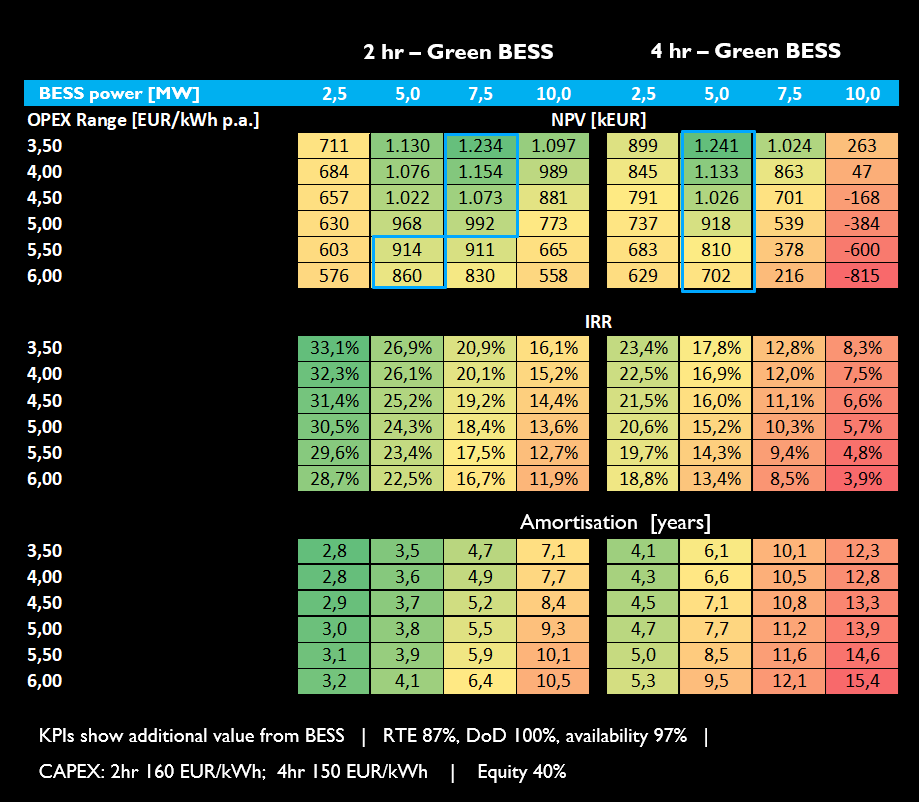
Operating costs influence project value and returns across all battery configurations. However, the preferred storage size often remains stable despite changing OPEX assumptions.
In our example:
- The 5 MW / 4h configuration remains economically robust even under higher OPEX assumptions.
- As OPEX increases, the advantage of the 7.5 MW / 2h configuration diminishes, while the 5 MW / 2h configuration delivers increasingly higher NPVs.
Financing Sensitivity
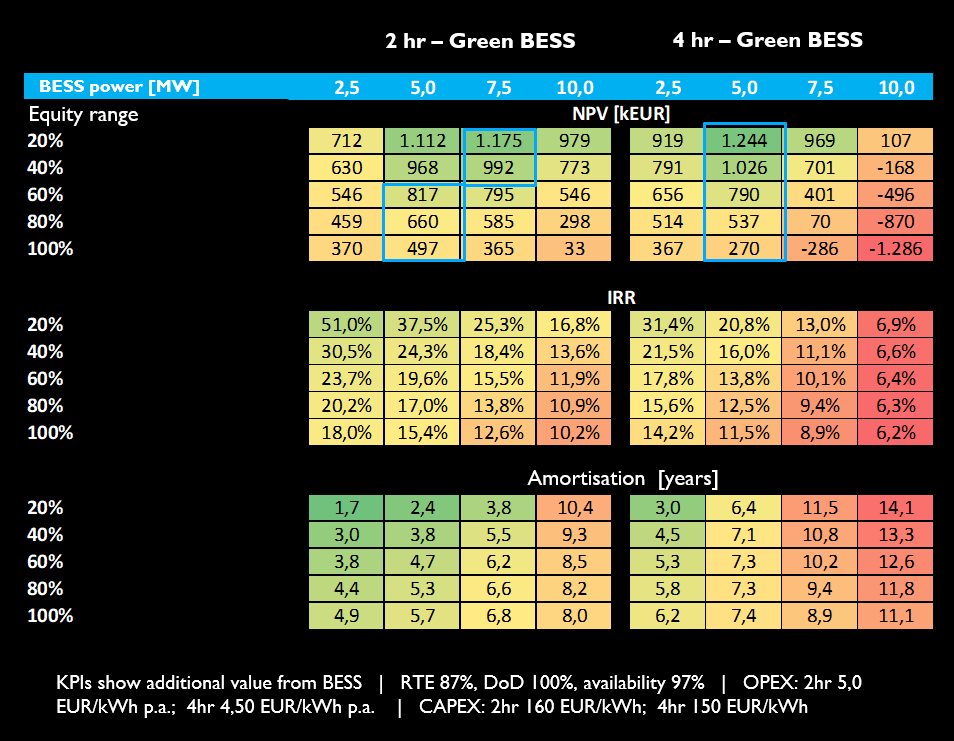
Financing assumptions can have a significant impact on project performance. Understanding how different battery configurations react to leverage is therefore a key part of any investment assessment.
In our example:
- The 5 MW / 4h configuration remains economically attractive across all equity ratios considered.
- The 7.5 MW / 2h configuration benefits particularly from financial leverage, while the 5 MW / 2h configuration appears more robust at higher equity ratios.
- Larger 4h systems are more sensitive to increasing equity shares.
Looking for Robust Solutions
The objective is not to maximise battery size. The objective is to identify the configuration that creates the most value under realistic market conditions while remaining robust across a range of future scenarios.
Successful projects typically balance flexibility, revenue generation, investment costs and financing requirements rather than optimising for a single metric.
Conclusion
The optimal battery size cannot be determined through rules of thumb. It is the result of a project-specific assessment that combines market opportunities, technical constraints, financing assumptions and commercial objectives.
Every project is different. The optimal battery configuration should be too.
In our example, 4-hour systems achieve their economic optimum at around 50% of PV capacity, while 2-hour systems remain attractive in the 50–75% range.
Grid connection capacity and permitting frameworks should be planned with future flexibility in mind – it is easier to build smaller initially than to expand later.
- Standard battery configurations offered by manufacturers should be considered from the beginning.
- The final sizing decision should always be based on project-specific parameters.
Interested in evaluating the optimal battery configuration for your project? Electric Blue's Revenue & Optimisation Studies combine market intelligence, techno-economic modelling and real-world trading expertise to identify robust, value-maximising solutions for renewable energy and storage projects.