
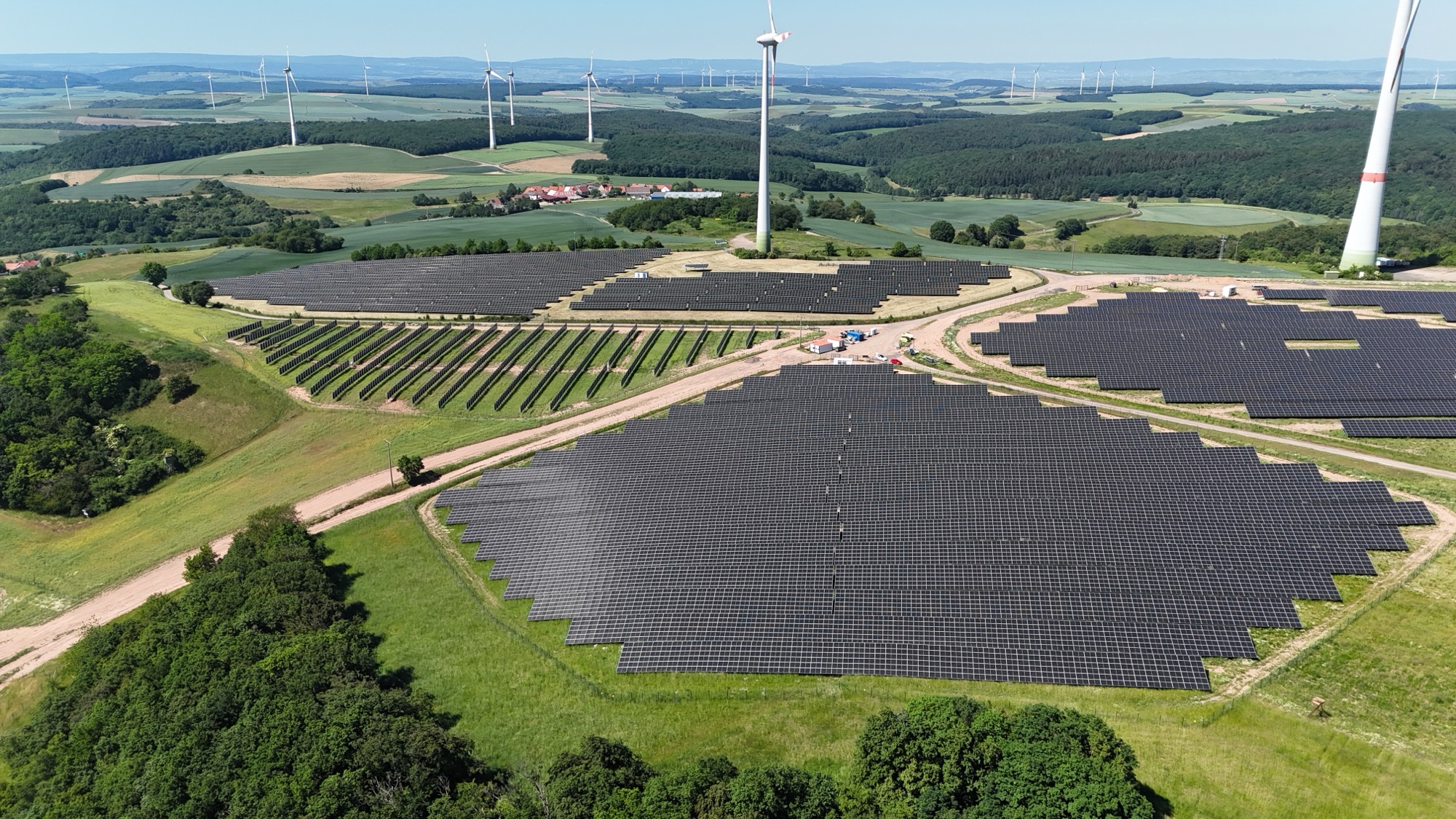
Schneebergerhof Energy Park (image source: wi renewables GmbH)
More from every megawatt of grid connection: Electric Blue takes over the marketing of the Schneebergerhof Energy Park from 2027
Wind, photovoltaics, a high-tech greenhouse and soon a green power storage system, all behind one shared grid connection: the Schneebergerhof Energy Park in Gerbach (Rhineland-Palatinate) is one of the most exciting hybrid projects in Germany. Electric Blue has been advising the operating company Wi IPP from Mainz since spring 2026, including on yield projections and self-sufficiency calculations. From 1 January 2027, we will take over the marketing and optimisation of the park.
A greenhouse that runs on wind and sun
At the heart of the site is the model project “Agrarvision Gewächshaus” (Agrarvision Greenhouse). On around 3,500 m², potted herbs, lettuces and tomatoes are grown in three separate cultivation systems. The greenhouse was opened in March 2026 by Rhineland-Palatinate’s Climate Protection Minister Katrin Eder and is considered one of the most modern high-tech greenhouses in Germany. The farm at Schneebergerhof in Gerbach was the family farm of energy transition pioneer Matthias Willenbacher and today combines sustainable agriculture with wind and solar projects.
What makes it special: the electricity for the greenhouse comes entirely from wind and solar plants right on site. To make this work, the project team of the wi group of companies started with consumption. Highly insulating polycarbonate cladding and three integrated energy screen systems reduce energy demand by up to 80% compared with conventional glass greenhouses. Lighting is provided by LEDs, heating by high-efficiency heat pumps, and a closed water cycle saves up to 90% of water.
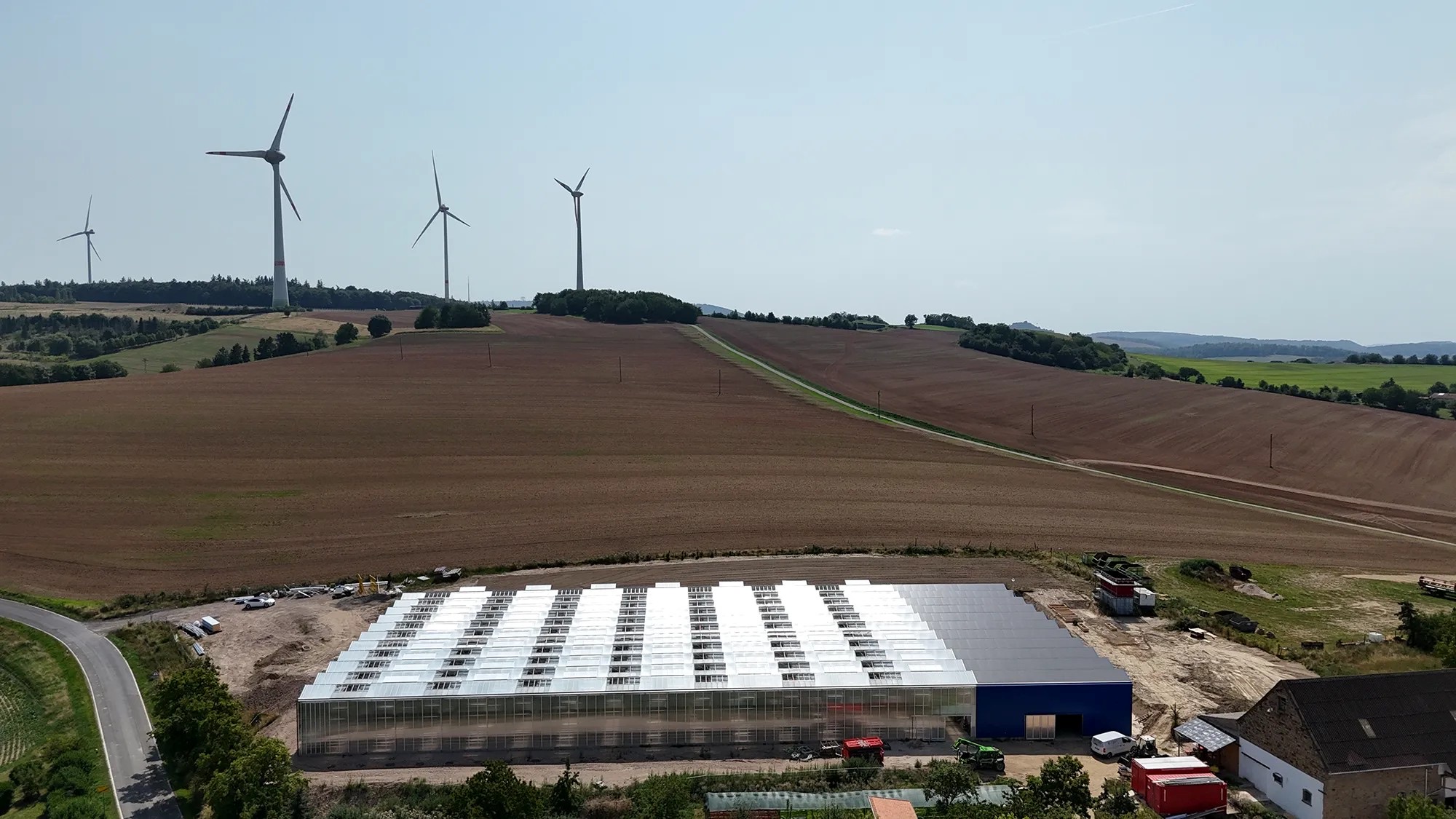
Figure: Aerial view of the Agrarvision Greenhouse model project (image source: wi renewables GmbH)
Grid connections are scarce, so every megawatt counts
For many renewable energy and storage projects today, the bottleneck is not land but the grid connection. Anyone who has a connection should make the best possible use of it.
That is exactly what is happening at Schneebergerhof. Around 13 MW of wind and solar capacity is installed at a 6 MW grid connection, and a battery storage system will be added in 2027. The connection is therefore overbuilt by more than a factor of two. This works because wind and sun complement each other well over time, because a large share of the electricity is consumed on site, and because the storage system shifts electricity into hours when there is spare capacity at the grid connection and the electricity is worth more.
The set-up at a glance
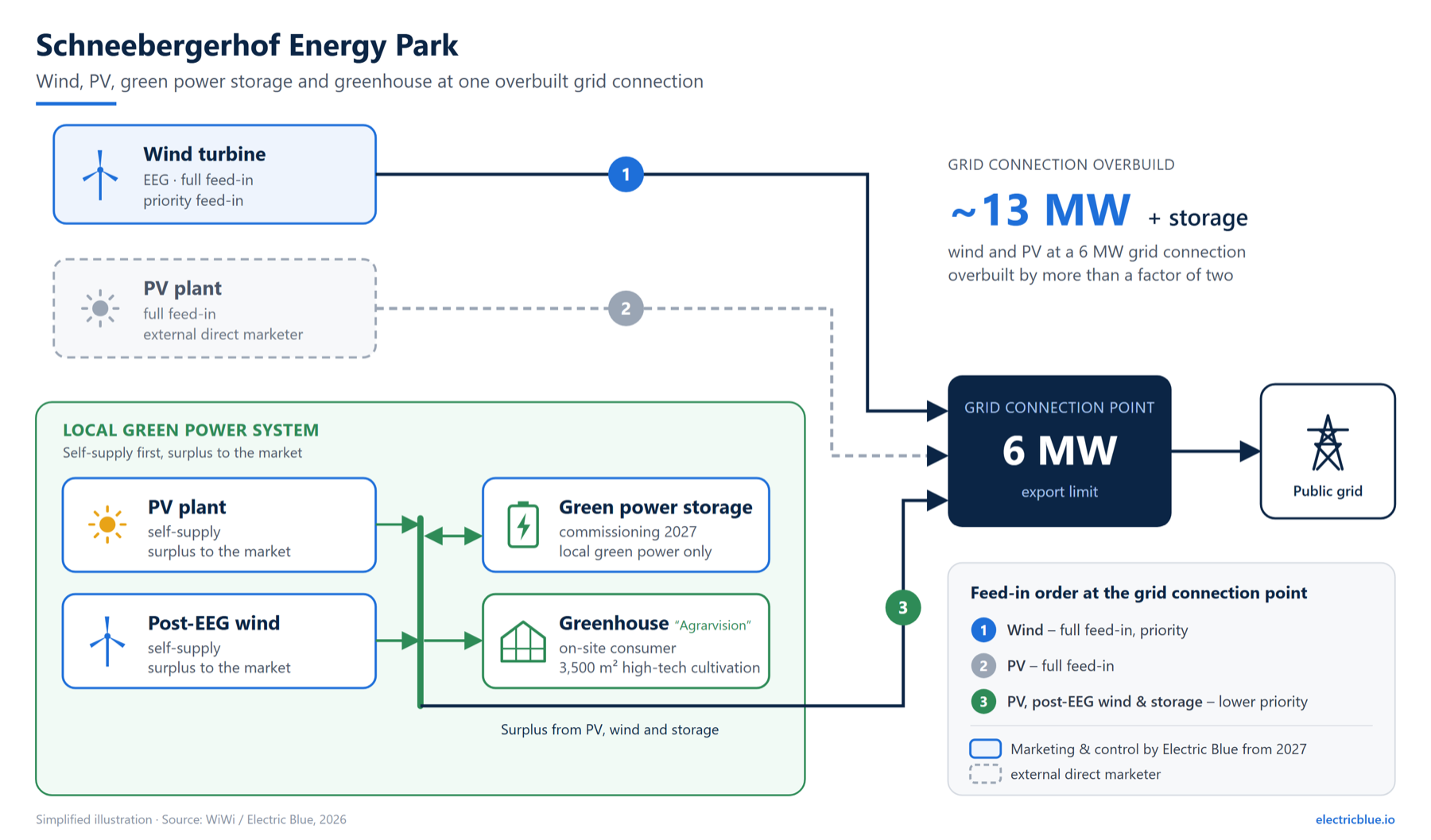
Figure: Set-up and feed-in order at the grid connection of the Schneebergerhof Energy Park
The energy park consists of two parts:
- Full feed-in plants: A wind turbine and a PV plant feed all of their electricity into the grid.
- Local green power system: A second PV plant and a post-EEG wind turbine (one whose support under the German Renewable Energy Sources Act, EEG, has expired) primarily supply the greenhouse. Whatever is not needed there goes into the storage system or to the electricity market. The green power storage system is charged exclusively with electricity generated on site.
The post-EEG turbine is a good example of how the operating company Wi IPP thinks: instead of dismantling a turbine that is no longer subsidised, it becomes the core of the self-supply. Its generation profile is a good match for the greenhouse’s consumption, which peaks in winter.
Because no more than 6 MW may ever be fed in at the grid connection, a fixed feed-in order applies:
- the wind turbine with full feed-in,
- the PV plant with full feed-in,
- the local green power system comprising PV, post-EEG wind and storage. It uses the remaining capacity once the greenhouse has been supplied.
Why projects like this need specialised marketing
From a marketing perspective, the Schneebergerhof Energy Park is demanding. How much the local system may feed in depends, in every quarter-hour, on how much the priority plants are generating at that moment. At the same time, the greenhouse must be supplied reliably, and the storage system is meant to earn revenue without jeopardising self-supply.
Good marketing here means forecasting and controlling many variables at once: the generation of all wind and PV plants, the greenhouse load, the storage system’s state of charge, the available capacity at the grid connection and prices on the day-ahead and intraday markets. A standard direct marketing approach that looks at each plant in isolation leaves value on the table.
Our role: from advisory to marketing
Advisory and yield projections. Ahead of the storage expansion, we advised Wi IPP on the design and evaluation of the overall system. This work was based on our optimisation model FLOW. FLOW combines machine learning, mathematical optimisation and the decision logic of our trading. It simulates operation the way it happens in practice: with imperfect foresight, real trades and all technical constraints.
We prepared yield projections over the project lifetime, determined the greenhouse’s degree of self-sufficiency and validated the results in a backtest with real data. The key findings:
- Almost 100% self-sufficiency: With storage, the greenhouse can be supplied almost entirely with electricity generated on site.
- Around 70% less curtailment: The storage system absorbs solar power that would otherwise have to be curtailed at negative prices. Curtailment of the wind turbine is avoided almost entirely.
- Significantly higher revenues: The storage system shifts electricity from low-price to high-price periods and substantially increases the market revenues of the local system.
Marketing from 2027. From 1 January 2027, we will market the plants and optimise the storage system. We treat the park as one system, not as a collection of individual plants. Live metering data from all units, including the greenhouse, flows into our virtual power plant. We also take on balancing group responsibility, the imbalance risk and the roles of dispatch-responsible party (EIV) and technical resource operator (BTR) under Redispatch 2.0.
AI-based trading meets hybrid expertise
Electric Blue has been running AI-based algorithmic trading on the spot market since 2018. Since 2022, we have been using the same platform to market wind, solar, storage and hybrid assets. Our customers therefore benefit directly from models that have to prove themselves every day in our own trading.
For projects like the Schneebergerhof Energy Park, we bring two things together:
- Algorithms: Our models continuously forecast generation, consumption and prices and make trading and dispatch decisions until shortly before delivery. They allocate storage and generation volumes across the day-ahead and intraday markets while automatically respecting constraints such as the export limit at the grid connection.
- Experience with complex hybrid projects: Our team of energy and AI specialists knows the energy-industry and regulatory specifics of co-location and hybrid projects. These include overbuilt grid connections, feed-in priority rules, green power storage, EEG and post-EEG plants, and on-site consumers.
This allows us to support projects from the first advisory meeting through the investment decision to day-to-day operation, with the same models and the same contacts.
A model for the energy transition
The Schneebergerhof Energy Park shows how much value can be created at a single grid connection when generation, consumption and storage are planned together. Wi IPP has consistently thought the synergies through: a wind turbine past its subsidy period with a new role, a highly efficient greenhouse that produces regional food with electricity from its own site, a storage system that charges only green power, and a grid connection that is used far more effectively.
We are delighted by the trust Wi IPP has placed in us and look forward to developing the Schneebergerhof Energy Park further together from 2027.
Are you planning a hybrid project, looking to add storage to an existing site or wanting to make better use of your grid connection? Get in touch: electricblue.io