
Revenue Streams of PV+BESS Hybrids
The stacked revenue streams that define green battery hybrid projects, and where storage creates the most economic value.
As renewable energy penetration continues to grow, electricity prices increasingly reflect the timing of generation.
For solar assets in particular, periods of high generation often coincide with lower market prices, while demand-driven evening hours tend to command significantly higher prices.
This creates an opportunity for battery storage.
Monetising Temporal Price Spreads
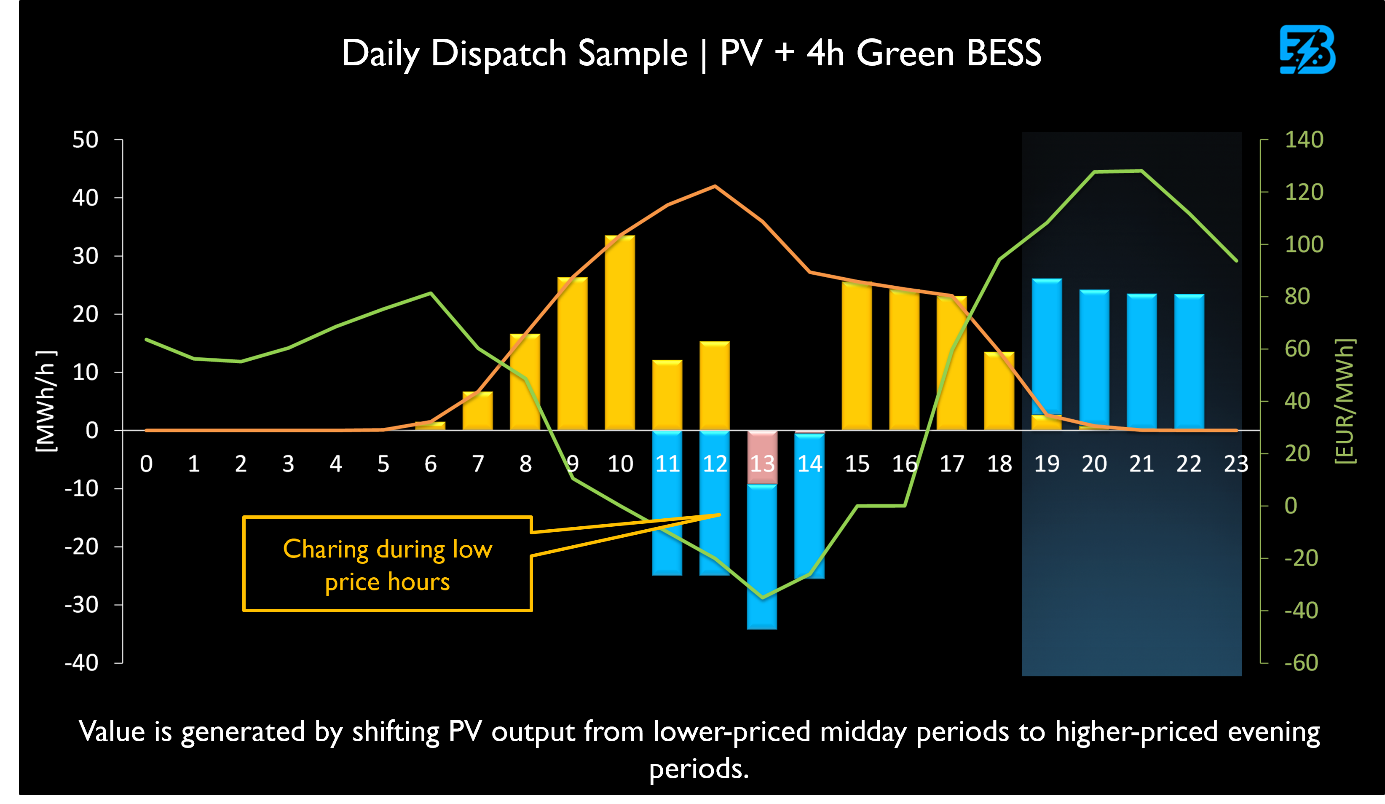
A green energy storage system creates value by shifting renewable generation from lower-priced periods into higher-priced periods.
Rather than selling electricity when it is produced, storage allows project owners to deliver energy when market conditions are more favourable. For solar projects, this typically means storing energy during midday hours and discharging during the evening peak.
The result is not additional generation, but a higher value for the same renewable energy.
The Power of Flexibility
The value of a battery lies in its flexibility.
By decoupling generation from delivery, storage transforms renewable energy from a fixed production profile into a flexible market product.
As electricity markets become increasingly volatile and renewable penetration continues to increase, this flexibility becomes a growing source of value.
Additional Revenues Through Market Optimisation
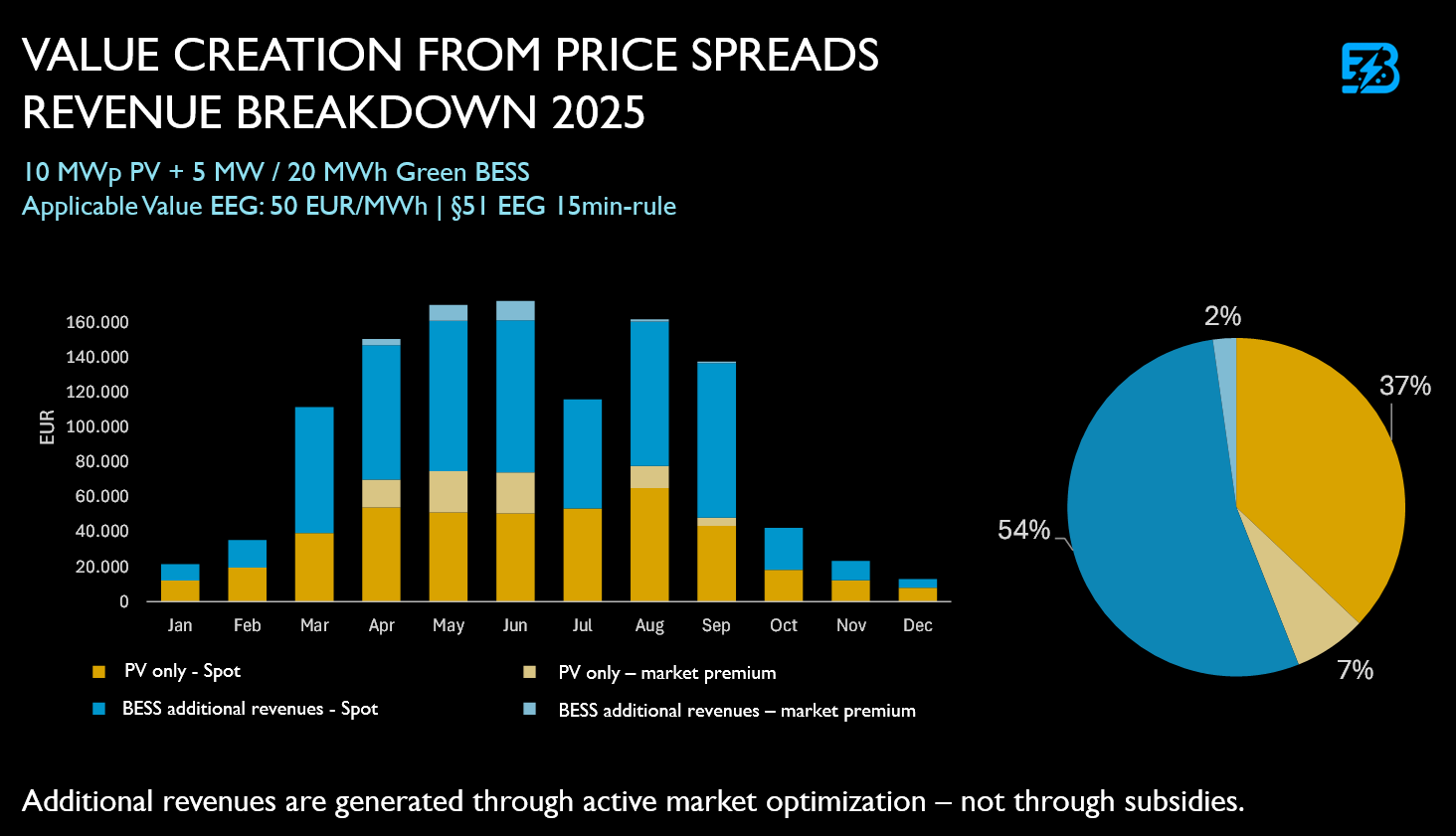
Our analysis of a solar project combined with a green energy storage system shows that a substantial share of total project revenues can be generated through storage-enabled market optimisation.
These revenues do not arise from additional subsidies or support mechanisms. They are created by actively capturing market opportunities and monetising price spreads that would otherwise remain inaccessible.
In other words: the battery does not create energy. It creates optionality.
How Additional Value Scales
The value created by green energy storage can be substantial. However, the relationship between storage size and additional revenues is not linear.
Our analyses show that storage systems can generate significant incremental revenues compared to standalone renewable generation assets. Depending on the project configuration, storage duration and market environment, the additional value can reach well over €100,000 per MW of battery power per year.
At the same time, revenue generation is highly dependent on how flexibility is utilised. Project configuration, operating strategy and market conditions all play an important role in determining the achievable value.
Understanding these dynamics is essential when evaluating the potential of a storage project and comparing different development concepts.
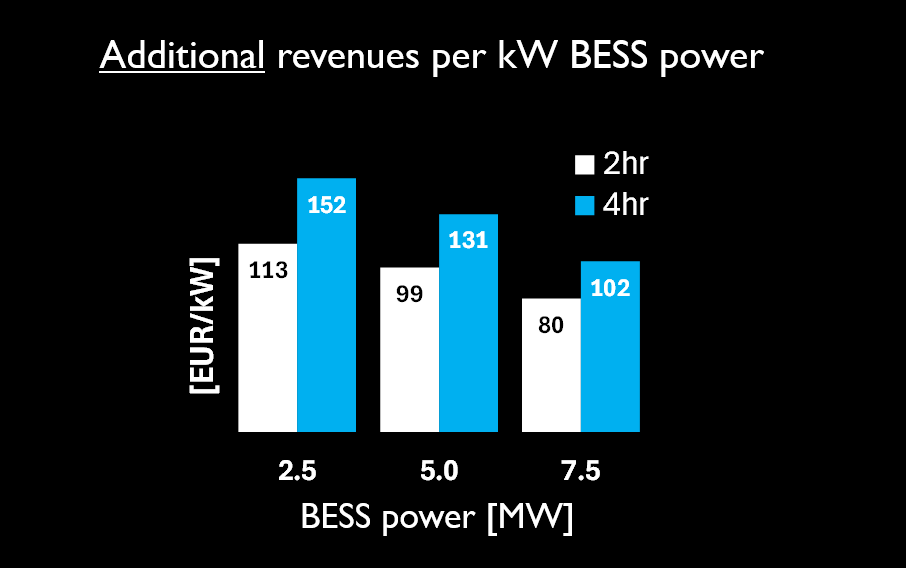
Illustrative example of annual additional revenues generated by green energy storage under different battery configurations.
Looking Beyond Revenues
While additional revenues are an important part of the story, they are only one piece of the puzzle.
Questions such as optimal battery sizing, project economics and overall investment returns require a broader analysis of both revenues and costs.
We explore these aspects in a separate article:
Conclusion
Green energy storage systems unlock value by adding flexibility to renewable generation.
As power markets become increasingly dynamic, the ability to shift energy across time will play a growing role in project performance. Understanding where this value comes from is the first step towards developing successful renewable and storage projects.